Outdoor displays face a challenge that rarely comes up with indoor equipment: sunlight can make an otherwise clear screen difficult to read.
Consider a payment terminal at a fuel station, a marine navigation screen, or a handheld device used by a field technician. The display may work perfectly indoors, yet become almost unreadable at midday. Reflections cover the text, dark areas turn gray, and users struggle to see what is on the screen.
Two common ways to address this are high-brightness TFT LCD backlights and optical bonding. One increases the amount of light coming from the display. The other reduces reflections within the display assembly.
Both can improve outdoor readability, but they have different effects on power consumption, heat, durability, and manufacturing cost. Understanding those differences helps engineers choose a suitable display for their equipment.
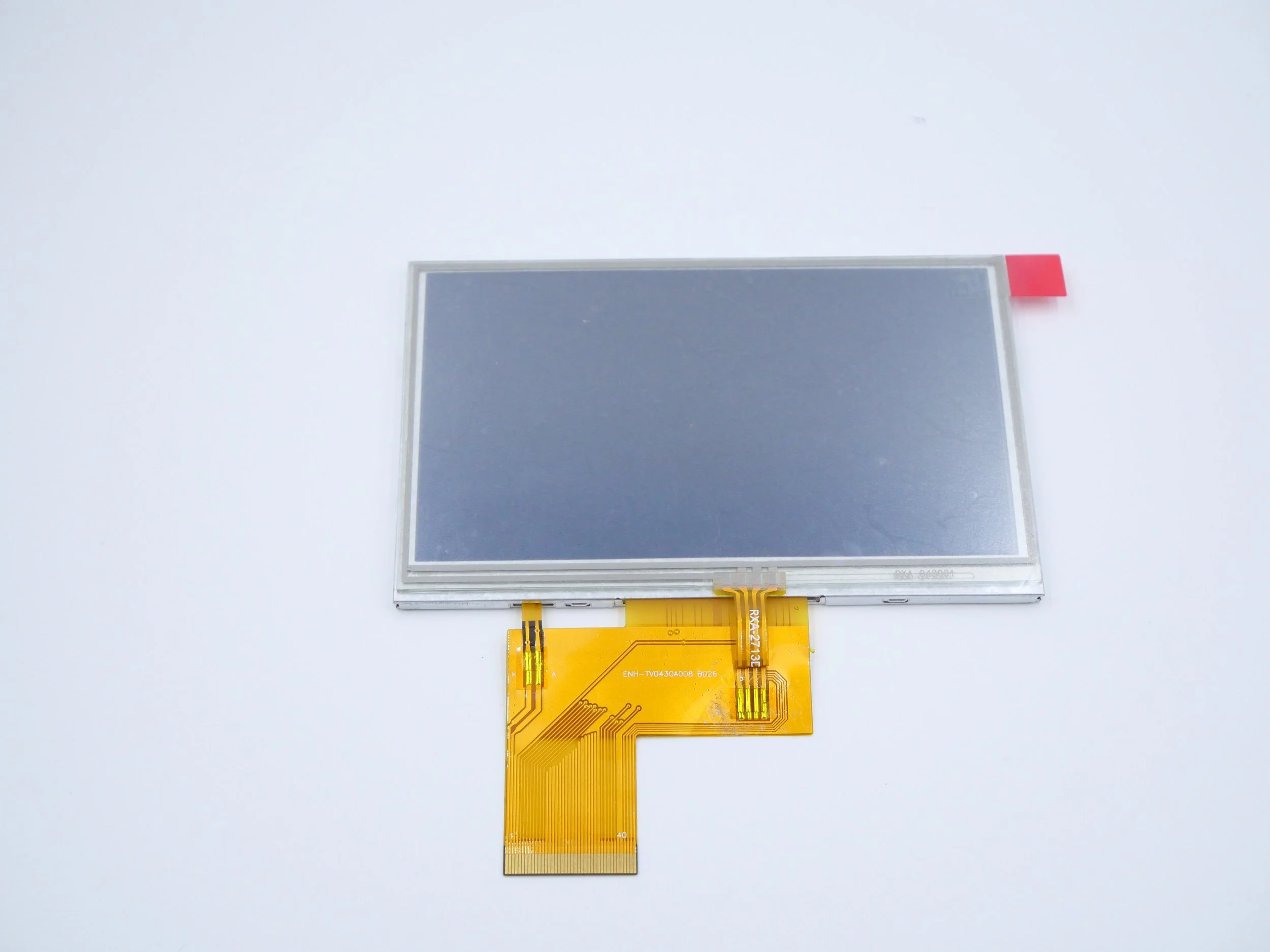
Why Are TFT LCDs Difficult to Read in Direct Sunlight?
Direct sunlight can exceed 100,000 lux, far brighter than typical indoor lighting. Under these conditions, light reflected from the surface and internal layers of an LCD can overpower the image produced by its backlight.
A conventional TFT LCD assembly usually consists of several layers:
Cover glass or protective lens
Air gap between the cover glass and LCD
Front polarizer
TFT LCD panel
LED backlight assembly
In an air-bonded display, the cover glass is attached around its edges, leaving a gap between the glass and LCD surface.
The gap introduces additional reflective boundaries. At a typical glass-to-air interface, approximately 4% of normally incident light can be reflected, although the actual amount depends on the materials, coatings, and viewing angle.
These reflections become particularly noticeable outdoors. Bright images may remain visible, but darker text and graphics lose contrast as reflected sunlight adds unwanted brightness across the screen.
Brightness Is Only Part of the Answer
LCD brightness is measured in nits, or candelas per square meter (cd/m²).
An ordinary indoor TFT LCD may produce around 250–350 nits. Outdoor-oriented displays often use backlights rated at 800–1,000 nits or higher.
Increasing brightness helps, but sunlight readability also depends on how much ambient light the display reflects.
For example, a 1,000-nit screen with strong surface reflections may be harder to read than another screen with a similar brightness rating and better reflection control.
This is why engineers should consider both display luminance and ambient contrast, rather than selecting an LCD solely by its advertised nit rating.
High-Brightness TFT LCDs: Increasing Backlight Output
A high-brightness TFT LCD uses a stronger LED backlight to improve visibility under bright ambient lighting.
Compared with a standard indoor display, the backlight assembly may use additional LEDs, more efficient optical films, or a light-guide structure optimized for higher output.
The basic principle is straightforward: increasing the display's emitted light makes its image easier to distinguish from reflected ambient light.
How Bright Should an Outdoor TFT LCD Be?
The brightness required depends on where and how the equipment is used.
These ranges are general starting points, not guaranteed readability thresholds. Actual performance depends on surface reflectance, viewing angle, display content, and surrounding conditions.
Advantages of High-Brightness LCD Modules
One advantage of a high-brightness backlight is that it can sometimes be introduced without changing the entire display structure.
For products already using a standard TFT LCD, a manufacturer may be able to develop a higher-output backlight while retaining the original panel size, resolution, and interface.
This can be useful for outdoor industrial equipment with established mechanical dimensions.
High-brightness modules are also practical where a stable power supply is available, such as fixed kiosks, vehicle dashboards, and industrial control terminals.
However, increasing brightness also creates additional engineering requirements.
Heat and Power Consumption
High-output LED backlights require more electrical power and generally produce more heat than lower-output versions of comparable displays.
This becomes important when the LCD is installed inside a sealed enclosure.
A screen operating at 1,500 nits inside an outdoor kiosk may receive heat from its own LEDs while also absorbing solar radiation through its front glass and housing.
If that heat cannot escape, the LCD panel and surrounding electronics may exceed their specified operating temperatures.
Possible consequences include:
Reduced LED backlight lifetime
Increased battery consumption
Changes in LCD response time
Temporary display discoloration or black areas caused by excessive panel temperature
Reduced reliability of drivers and other electronic components
For battery-powered equipment, operating a high-brightness backlight continuously at maximum output can also shorten operating time.
An ambient light sensor can help by reducing backlight current when full brightness is unnecessary.
Other measures include thermally conductive backplates, heat-spreading structures, and appropriate enclosure materials.
The key is to assess heat dissipation during display selection rather than treating it as a problem to solve after the enclosure is finished.
Optical Bonding LCDs: Reducing Internal Reflections
Optical bonding takes a different route.
Instead of relying entirely on a brighter backlight, it improves visibility by reducing reflections between the LCD panel and its protective cover glass.
In a conventional air-bonded display, the air gap separates the cover glass from the LCD polarizer.
In an optically bonded assembly, that space is filled with a transparent optical adhesive.
The adhesive has a refractive index closer to that of the surrounding optical materials than air does. This reduces the amount of light reflected at the internal boundaries.
As a result, the displayed image can retain better contrast under strong ambient light.
How Optical Bonding Works
Two common adhesive technologies are used in LCD optical bonding.
OCA (Optically Clear Adhesive)
OCA is supplied as a transparent adhesive film. It is widely used for bonding flat display surfaces, touch panels, and cover glass.
The film has a controlled thickness and is suitable for production processes where the bonding surfaces have compatible shapes and dimensions.
OCR (Optically Clear Resin)
OCR is a liquid optical adhesive that is dispensed between display layers and then cured.
Depending on the resin formulation, curing may use ultraviolet light, heat, or a combination of processes.
Liquid adhesive can be useful when the assembly includes stepped surfaces or other features that are difficult to accommodate with a uniform adhesive film.
Neither technology is universally better. The choice depends on panel dimensions, cover glass geometry, adhesive thickness, production yield, and long-term environmental requirements.
Optical Bonding vs. Air Bonding
Optical bonding can improve outdoor display performance, but the results depend on adhesive quality, bonding thickness, and the optical properties of the full assembly.
It does not automatically make a display waterproof, impact-proof, or suitable for every outdoor environment.
Can Optical Bonding Reduce Backlight Power Consumption?
In some applications, yes.
Because optical bonding reduces unwanted reflections, it may allow an LCD to achieve acceptable outdoor readability with less backlight output than a comparable air-bonded assembly.
For example, an engineering team might evaluate a bonded 1,000-nit display against a brighter air-bonded alternative.
If the bonded screen meets the required outdoor contrast and viewing conditions, the lower backlight setting may reduce electrical demand and heat generation.
However, this is not a fixed relationship.
A bonded 1,000-nit LCD is not necessarily equivalent to an unbonded 1,800-nit LCD. Performance depends on the surface reflectance, panel contrast, optical stack, and angle of incident sunlight.
For this reason, readability should be checked under representative lighting conditions before finalizing a backlight specification.
Anti-Reflective and Anti-Glare Glass for Outdoor Displays
Optical bonding reduces internal reflections, but it does not eliminate reflections from the outer surface of the cover glass.
That surface remains exposed to air, sunlight, and surrounding objects.
Outdoor TFT LCD assemblies often use additional glass treatments to improve visibility.
Anti-Reflective (AR) Coating
Anti-reflective coatings reduce the amount of light reflected from the glass surface.
They typically use thin-film optical layers to suppress reflections over a selected wavelength range.
A well-specified AR coating can significantly reduce surface reflectance, although performance varies with coating construction and viewing angle.
AR glass is particularly useful when sharp reflections make a screen difficult to read.
Anti-Glare (AG) Treatment
Anti-glare glass uses a textured surface to spread reflected light over a wider area.
Rather than producing a sharp reflection of the sun or surrounding objects, the surface creates a softer, more diffuse reflection.
This can improve viewing comfort, especially on displays used from several angles.
However, excessive surface haze can reduce image clarity. Engineers should balance glare reduction against the text sharpness required by the application.
Anti-Fingerprint (AF) Coating
Anti-fingerprint coatings help reduce the visibility and adhesion of oils left by users' fingers.
They also make the glass easier to clean.
This is useful for outdoor payment terminals, public information kiosks, and industrial touchscreens that receive frequent contact.
AF coatings mainly improve surface cleanliness and maintenance. They are not a substitute for AR coating or optical bonding.
For demanding outdoor applications, manufacturers may combine optical bonding with AR, AG, or AF treatments according to the intended environment.
High-Brightness Backlight vs. Optical Bonding: Which Is Better?
These technologies are not direct replacements for each other.
A brighter backlight increases emitted light, while optical bonding reduces internal reflections. Many outdoor products benefit from using both.
The more useful question is how much brightness and reflection control the equipment actually needs.
For a display that operates under an awning or inside a vehicle cabin, a brighter backlight with suitable cover glass may be sufficient.
For a handheld terminal or marine display exposed to direct sunlight, optical bonding becomes more attractive, especially when power consumption is limited.
In some cases, a combination of 1,000–1,500 nits, optical bonding, and anti-reflective glass offers a practical balance. The actual brightness target still needs to be confirmed through application-specific evaluation.
Choosing a Sunlight-Readable TFT LCD for Different Applications
Different outdoor products place different demands on an LCD. Screen size, operating time, available power, and environmental exposure all affect the choice.
Outdoor Payment Kiosks
Payment kiosks and ticketing machines often operate for long periods and may be exposed to direct sunlight.
A high-brightness TFT LCD can help users read instructions and complete transactions during the day.
Optical bonding and AR glass may further reduce reflections, particularly when the kiosk faces an open street or parking area.
For sealed installations, thermal performance should be checked at the highest expected ambient temperature.
Marine Navigation Displays
Marine displays are exposed to changing sunlight angles, water spray, vibration, and high humidity.
Optical bonding can reduce internal reflections and eliminate the air cavity between the LCD and cover glass, helping avoid condensation at that interface.
However, the overall enclosure still needs appropriate sealing and corrosion-resistant construction.
The display should also be evaluated for readability when viewed from different positions around the vessel.
Industrial Handheld Terminals
Portable devices have stricter power limits than permanently installed equipment.
A very bright LCD may improve outdoor visibility but can reduce battery runtime.
Optical bonding can be useful in these products because it improves contrast without requiring additional operating power from the bonding layer.
Automatic brightness adjustment can further reduce energy consumption when the terminal is used indoors or in shaded conditions.
Vehicle and Agricultural Equipment
Vehicle displays must remain readable as ambient lighting changes.
A screen may be exposed to direct sunlight, shadows, dashboard reflections, and vibration during the same working day.
For agricultural machinery, construction vehicles, and fleet equipment, the selection should account for brightness, optical bonding, temperature range, and mechanical mounting.
In addition, the LCD backlight and controller should be compatible with the vehicle's electrical system.
Temperature Resistance Matters as Much as Brightness
Outdoor LCD selection should not stop at sunlight readability.
The display must also operate within the temperature range expected inside the finished equipment.
For example, the air inside an enclosure exposed to direct sunlight can become significantly hotter than the surrounding environment.
At low temperatures, liquid crystal response may slow, creating visible motion effects or delayed screen transitions.
At excessively high temperatures, a TFT LCD may experience temporary optical changes, including reduced contrast or dark areas.
Industrial displays are available with extended operating-temperature specifications, but the actual range depends on the selected panel, backlight, polarizers, bonding materials, and electronic components.
A complete assembly should be assessed rather than relying on the LCD cell's temperature rating alone.
For outdoor equipment, engineers should confirm operating and storage temperature limits, expected enclosure temperatures, and any required thermal cycling or environmental qualification.
Custom Sunlight-Readable TFT LCDs from Changchun Fangguan
Standard LCD modules do not always fit the mechanical or optical requirements of industrial equipment.
A product may require a specific screen size, customized cover glass, unusual cable routing, or a backlight that works within a limited power budget.
Changchun Fangguan Electronics Technology Co., Ltd. provides customized TFT LCD assemblies for industrial and outdoor applications.
Depending on project requirements, customization options include:
High-Brightness LED Backlights
Custom LED backlight assemblies can be developed for higher luminance, including configurations targeting up to 2,500 nits, subject to panel compatibility and thermal requirements.
Optical Bonding
OCA or OCR bonding can be incorporated to reduce internal reflections between the cover glass, touch panel, and LCD.
Custom Cover Glass
Cover lenses can be tailored for dimensions, thickness, edge profiles, printed borders, and appropriate surface treatments, including AR, AG, and AF coatings.
Industrial Temperature Requirements
LCD panels and assembly materials can be selected according to the intended operating-temperature range.
Mechanical and Electrical Customization
FPC cable routing, backlight drivers, mounting arrangements, and touch-panel integration can be adapted to the host equipment.
For custom projects, the most useful starting information includes the required display dimensions, target brightness, viewing environment, operating temperature, available power, and expected production quantity.
These details help determine whether a high-brightness backlight, optical bonding, or a combined assembly is the most practical choice.
What to Check Before Ordering an Outdoor TFT LCD
Before choosing a display supplier or confirming a custom LCD specification, engineers should collect the operating requirements.
Providing these specifications early can reduce unnecessary revisions during display development.
It also makes it easier to compare different LCD configurations on technical grounds rather than comparing brightness specifications alone.
Final Thoughts
A sunlight-readable TFT LCD needs more than a powerful backlight.
Increasing LED brightness is a practical way to improve visibility, particularly where electrical power and thermal management are readily available. However, higher luminance also increases demands on the power supply and cooling arrangement.
Optical bonding addresses a different part of the problem by reducing reflections inside the display assembly. It can improve perceived contrast, reduce parallax, and eliminate the air gap where internal condensation might otherwise occur.
For equipment exposed to strong sunlight, combining a suitable high-brightness backlight with optical bonding and anti-reflective cover glass is often worth evaluating.
The final choice should be based on actual viewing conditions, power limits, operating temperature, and enclosure construction. A display that performs well in one outdoor installation may not be suitable for another.
Frequently Asked Questions
1. Is a 1,000-nit TFT LCD readable in direct sunlight?
A 1,000-nit TFT LCD can provide useful outdoor readability, but its performance depends on reflections, display contrast, viewing angle, and sunlight intensity.
Optical bonding and anti-reflective glass can improve visibility. For particularly demanding conditions, higher brightness may be necessary.
2. Can optical bonding make a standard 250-nit LCD sunlight-readable?
Optical bonding can improve visibility by reducing internal reflections, but it cannot compensate for insufficient backlight brightness in every environment.
A 250-nit display may still be difficult to read under strong direct sunlight, even when optically bonded.
For outdoor applications, the display's brightness and reflected-light performance should be evaluated together.
3. Does optical bonding improve touchscreen performance?
Optical bonding reduces the physical separation between display layers, which can make on-screen graphics appear closer to the touch surface and reduce parallax.
However, touch sensitivity and response time depend primarily on the touch sensor, controller, firmware, and electrical characteristics. Bonding alone does not guarantee faster touch response.
4. What is the difference between OCA and OCR bonding?
OCA uses a transparent adhesive film, while OCR uses a liquid optical adhesive that is subsequently cured.
OCA is widely used for flat, consistent bonding surfaces. OCR may be better suited to certain assemblies with stepped structures or complex surface features.
The appropriate choice depends on the display structure and manufacturing requirements.
5. Does optical bonding prevent condensation?
Optical bonding removes the air cavity between bonded display layers, preventing condensation from forming within that particular gap.
It does not make the complete display enclosure waterproof or prevent condensation elsewhere inside the equipment.
Proper enclosure sealing is still necessary for outdoor applications.
6. What is the best TFT LCD for a sealed outdoor kiosk?
A high-brightness TFT LCD with optical bonding and suitable anti-reflective glass is often a strong candidate.
However, brightness, heat dissipation, enclosure temperature, operating conditions, and cost should all be assessed before selecting the final configuration.
7. Can Changchun Fangguan provide customized outdoor TFT LCD modules?
Changchun Fangguan Electronics Technology Co., Ltd. offers TFT LCD customization for industrial applications, including high-brightness backlights, optical bonding, cover glass customization, touch integration, and mechanical adaptations.
The available options and achievable specifications depend on the selected LCD panel and project requirements.