A driver rolls into an open-air charging station during a mid-summer heatwave. The midday sun blazes overhead, radiating heat off the concrete pad. They step up to authorize payment, only to find an unresponsive, blacked-out screen. Fast forward a few months to the same spot during a coastal winter deluge: driving rain streaks across the terminal, and pooled moisture triggers erratic phantom touches that lock the user out entirely.
Public charging hardware lives without shelter. Unlike consumer tablets or dashboard panels shielded by UV-filtered automotive glass, an EV charger display sits exposed to continuous thermal loads, moisture ingress, and blunt physical impacts. If the display fails, the charger is essentially offline.
Engineering a dependable EVSE LCD screen demands practical hardware decisions. Here is how to build display stacks that stay legible, responsive, and durable through extreme weather.
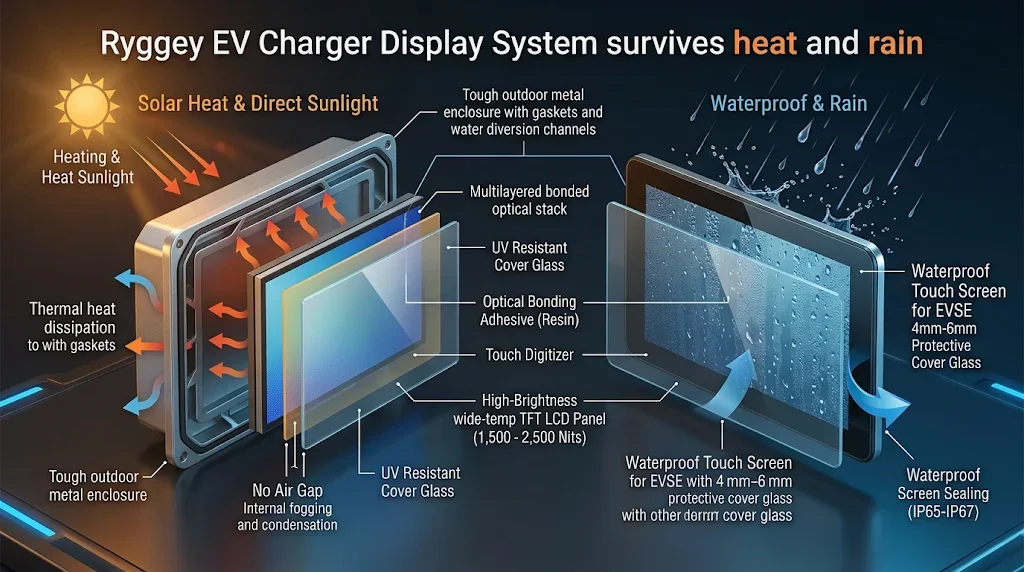
The Environmental Stress Factors Facing Charging Kiosks
Designing outdoor displays requires understanding how heat and moisture degrade standard electronics.
1. Solar Baking and the Black-Screen Failure
When direct sunlight strikes a dark enclosure, interior temperatures quickly exceed ambient conditions by 25°C to 35°C. Inside an enclosed charging post on an 40°C afternoon, internal cavity temperatures regularly top 75°C.
Commercial liquid crystal panels fail here. The liquid crystal material reaches its clearing point and transitions from its organized nematic state into an isotropic liquid. The result is a spreading, dark blotch across the active area. While the display usually recovers once temperatures drop, sustained cycling accelerates color-filter degradation and burns out backlight LEDs prematurely.
2. Moisture Ingress and Condensation Cycles
Wind-driven rain exploits microscopic gaps in bezels, fasteners, and cable glands. Ambient humidity poses an even quieter threat: diurnal thermal cycling creates a dew point inside non-bonded units. Warm, humid daytime air cools rapidly after dusk, condensing moisture against the interior face of the cover glass.
This internal fogging blinds the user. If unaddressed, moisture droplets migrate along flexible printed circuits (FPCs), causing corrosion and electrical shorts across driver boards.
Core Panel Selection: Brightness and Temperature Margins
Field survivability begins with the underlying panel architecture. Band-aid fixes cannot save a consumer-grade panel from outdoor degradation.
Sunlight Readability: Standard 350-nit screens wash out under open skies. Outdoor terminals require industrial panels rated at 1,500 to 2,500 nits. High-efficiency LED backlights paired with pulse-width modulation (PWM) dimming allow the screen to illuminate clearly at noon, then throttle back at night to reduce power draw and manage thermal loads.
Wide-Temperature Liquid Crystals: Specify panels with operating ranges between -30°C and +85°C. High-clearing-point liquid crystal fluids remain operational without suffering solar blackout in desert heat or turning viscous and sluggish during freezing blizzards.
Optical Bonding for an Outdoor EV Charging Station TFT Display
Traditional assemblies mount the cover glass over the LCD with an air gap supported by double-sided perimeter tape. For an outdoor EV charging station TFT display, this construction creates an immediate point of failure.
Optical bonding fills that gap with an optically clear resin (OCR) or dry silicone adhesive (OCA), fusing the cover glass, touch sensor, and TFT panel into a single solid unit.
Filling the air pocket removes internal glass surfaces where condensation can settle. Crucially, the solid adhesive layer acts as a thermal bridge. Instead of trapping heat generated by the backlight, optical resin conducts heat directly into the front glass face, where passing ambient air helps dissipate it.
Capacitive Touch Tuning: Designing a Waterproof Touch Screen for EVSE
Drivers expect smartphone-grade capacitive responsiveness, but falling raindrops carry electrical charges that confuse standard projected capacitive (PCAP) sensors. An uncalibrated sensor misinterprets running rain as physical contact, triggering erratic behavior or locking out valid inputs.
A reliable waterproof touch screen for EVSE depends on proper controller tuning:
Dual-Scanning Detection: Advanced touch ICs merge mutual capacitance (tracking multi-point gestures) with self-capacitance scanning (evaluating total surface charge).
Water-Rejection Firmware: The controller profiles input patterns to differentiate between broad, conductive water sheets and localized, high-density touches from a human finger. It suppresses ambient fluid noise while preserving tracking accuracy.
Glove and Heavy-Glass Tracking: Street hardware requires tempered front glass between 3mm and 6mm thick to hit IK08 to IK10 impact standards. Calibrating controller signal-to-noise ratios allows the system to read inputs through thick safety glass and heavy winter gloves without losing noise rejection.
Glass Surface Coatings and UV Protection
The outer glass layer serves as both an optical window and an environmental shield. Raw glass reflects roughly 4% of ambient light and offers little defense against continuous solar exposure.
Integrating UV resistant cover glass for EV charger applications requires matching chemical coatings to the working environment:
UV Blocking Filters: Incorporating UV-absorbing glass formulations or specialized interlayers prevents wavelengths below 400nm from degrading touch sensors and internal polarizers. It prevents adhesive yellowing and keeps perimeter decorative printing from flaking over years in the field.
Anti-Reflective (AR) Sputtering: Multi-layer optical coatings cut surface reflections down to less than 0.5%, increasing readability under direct glare.
Anti-Glare (AG) Chemical Etching: Etching the glass diffuses specular reflections, preventing sharp mirror-like reflections of the sky and passing vehicles.
Anti-Fingerprint (AF) Oleophobic Layer: Hydrophobic and oleophobic coatings cause rain to bead up and run off cleanly, while resisting fingerprint oils and road dust.
Enclosure Integration and Thermal Management
A well-specified screen relies on a properly engineered chassis. Poor sealing or inadequate thermal design will shorten the lifespan of even the toughest display panel.
Gasketing and Ingress Protection: Enclosures should meet at least IP65 standards, with IP66 or IP67 preferred for unsheltered sites. Use closed-cell silicone or expanded EPDM gaskets that resist compression set across wide temperature fluctuations.
Water Management Channels: Design internal drainage gutters around the display frame. Any moisture that pushes past external trim seals is routed around sensitive electronics and ejected through bottom drains.
Conduction Cooling Paths: Avoid pulling raw outdoor air through open vents into the display cavity, as this introduces dust and corrosive coastal salt fog. Instead, bridge the rear of the LCD backlight chassis to the charger’s metal frame using thermally conductive silicone gap pads, conducting internal heat outward through passive radiation.
Custom EV Display Solutions from Changchun Fangguan Electronics
Catalog displays rarely align with the structural, optical, and thermal profiles required by purpose-built charging pedestals. Customization is often necessary to balance mounting envelopes, driver board integration, and thermal survival.
Changchun Fangguan Electronics Technology Co., Ltd. engineers and manufactures ruggedized industrial display assemblies. Our product lines encompass:
High-brightness TFT panels (1,000 to 2,500+ nits) with custom LED driver designs
Optical bonding setups using silicone and acrylic resin formulations
Custom-tuned PCAP waterproof touch modules calibrated for thick glass and gloved input
Tailored cover-glass designs featuring chemically strengthened glass, ceramic frit borders, and AG/AR/AF optical coatings
By managing everything from liquid crystal selection to optical lamination and environmental sealing, Changchun Fangguan delivers ready-to-mount display assemblies designed to keep your chargers operational through any forecast.
Frequently Asked Questions
What luminance rating is necessary for outdoor charging displays?
Canopied or sheltered chargers typically function well with 1,000 to 1,500 nits. Stations installed under direct, unshaded sunlight require 2,000 to 2,500 nits paired with anti-reflective surface treatments to maintain clear readability throughout the day.
How does optical bonding stop display fogging?
Air-gap displays trap moisture that condenses on the cold inner glass surface as temperatures drop. Optical bonding completely fills this space with a transparent optical adhesive, leaving no air void where condensation can form.
Can a capacitive screen tell water droplets apart from fingers?
Yes. Modern touch controllers combine mutual and self-capacitance sensing. Firmware algorithms identify the wide, low-intensity electrical profile of running water or puddles and filter it out, only registering the concentrated capacitance spike created by a user's finger.
Why do some charging screens turn completely black during hot afternoons?
Standard consumer displays reach their liquid crystal clearing point when exposed to high ambient heat and solar radiation. The fluid turns isotropic and temporarily loses its ability to organize light. Using industrial-grade fluid with a high clearing point prevents this issue.
What cover-glass thickness works best for unattended public stations?
Chemically strengthened cover glass between 4mm and 6mm strikes the right balance. It provides IK08 to IK10 impact protection against vandalism while allowing sensitive touch controllers to track inputs cleanly through gloves.